A country you might not have on your radar just made a bold move in education.
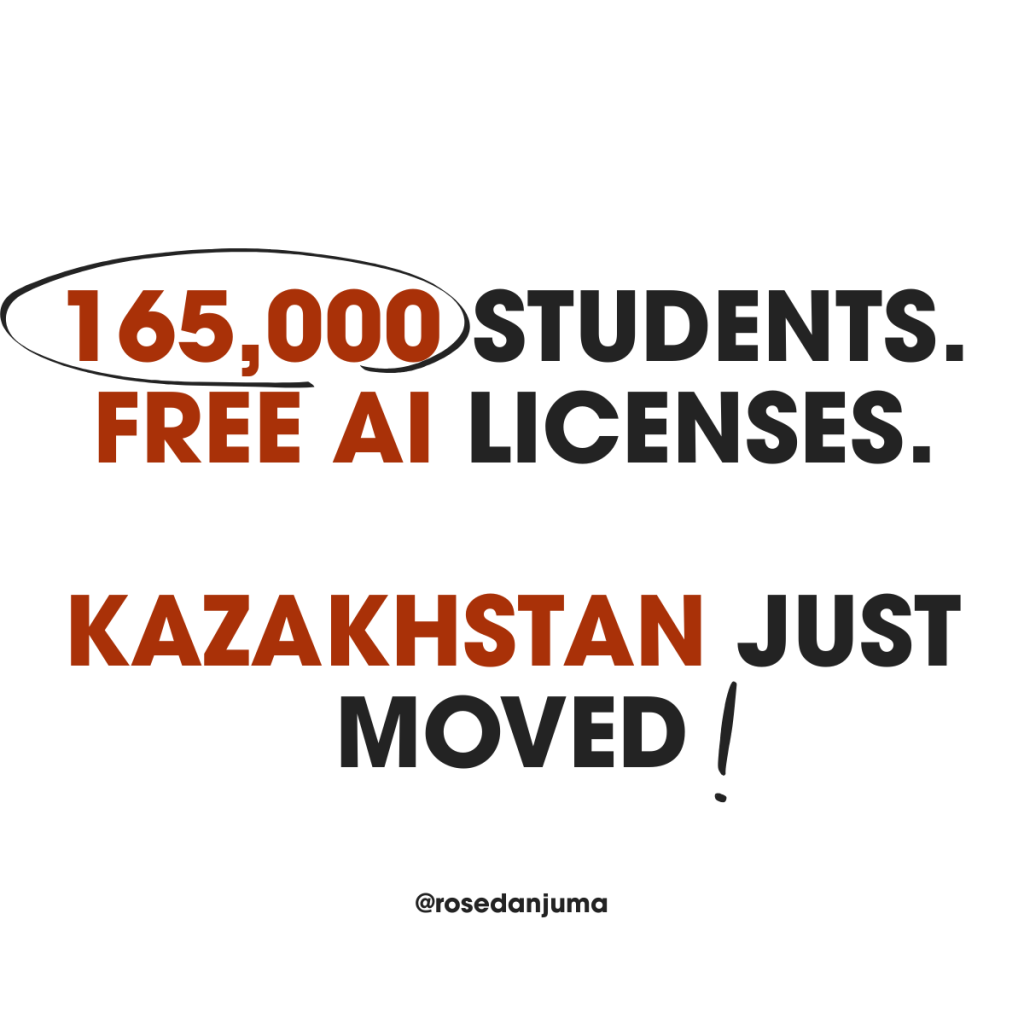
Kazakhstan, a nation in Central Asia, has become one of the first countries in the world to formally integrate artificial intelligence (AI) into its education system on a national scale, through a direct partnership with OpenAI.
This isn’t a pilot program. This isn’t a press release. This is real.
165,000 ChatGPT Edu licenses are being distributed free of charge across Kazakhstan’s education system, 100,000 for preschool, secondary, technical and vocational educators, over 62,000 for administrators and higher education faculty, and 2,200 for participants in the Astana Hub tech ecosystem.
ChatGPT Edu is a version of ChatGPT built specifically for academic institutions, offering access to OpenAI’s latest models alongside enterprise-level security, data privacy protections, and administrative controls, including data analysis, document summarisation, and the ability to create customised GPTs.
What struck me most was this quote from Valerie Focke, OpenAI’s lead for education across Europe, the Middle East and Africa: “We are seeing Kazakhstan as a pioneer and early mover among the countries to really start to think about it from the ground up, within its education system.” astanatimes
“… From the ground up. Within the education system.”
That phrase stopped me.
Because here’s what the article makes clear: the vision isn’t just about giving teachers a new tool, it’s about preparing students to become a workforce that is AI-ready, and thinking about how young people go on to use these tools to support things like public services.
If you ask me, this is nation-building through education.
So, where is Nigeria in all of this?
Nigeria has a National AI Strategy. Google has invested $2.1 million into AI skills programs.
Conversations are happening. But Kazakhstan didn’t just have conversations; they signed deals, distributed licenses, and started training teachers.
The rollout is being approached in phases, beginning with educators and supported by ongoing research, aimed at understanding the broader impact not only on education but on longer-term economic outcomes.
That phased, research-backed approach is exactly what thoughtful AI integration looks like.
Here’s my question for anyone in Nigerian education, edtech, or policy: what would it take for us to move from strategy to execution? From ambition to action?
Because the window to be an early mover doesn’t stay open forever.
And as educators, parents, and creators, we don’t have to wait for governments to act. We can start where we are. Teaching children to see patterns. Building curiosity before we demand calculation. That’s always been the real work.
I’d love to hear your thoughts.